Home / Top 10 hydraulic Cylinder Manufacturers in World
Top 10 hydraulic Cylinder Manufacturers in World
- Author: GY Hydraulic
- 20+ Years of Manufacturing
When selecting a global hydraulic cylinder manufacturer, you should focus on comparing whether the products are suitable for your equipment, the manufacturer’s customization capabilities, quality verification, and after-sales support. Brand recognition can serve as a reference, but what truly influences your purchasing decision is whether the manufacturer can meet your requirements for load capacity, operating pressure, installation space, and operating environment.
This article introduces 10 hydraulic cylinder manufacturers from around the world to help you understand their main products, application areas, and service features. Whether you are looking for a supplier for new equipment or purchasing replacement cylinders, you can use this information to create a shortlist of potential suppliers. You can then compare them based on drawings, test data, and quotes to find the partner best suited for your project.
Table of Contents
How the Global Hydraulic Cylinder Manufacturers Were Evaluated
When evaluating global hydraulic cylinder manufacturers, the focus should be on product compatibility, engineering and manufacturing capabilities, evidence of quality, and delivery and after-sales support. The purpose of this list is to help you screen suppliers; the order in which they appear does not represent a performance ranking based on standardized testing. Different manufacturers serve different types of equipment and operating conditions; a supplier suitable for large-scale mining equipment may not necessarily be suitable for small-batch automation projects.
The reliability of the information is the starting point for the evaluation. For corporate identity and product scope, official websites, technical catalogs, public reports, and official exhibitor materials should be the primary sources of reference. When it comes to production capacity, certifications, client partnerships, or performance advantages, it is essential to distinguish between “manufacturer-provided information” and “independently verified facts.” For example, if a website lists replacement cylinders for a specific brand of equipment, this only indicates the advertised compatibility range and does not directly prove that the manufacturer is an original equipment supplier for that brand. Projects for which no information is available should be marked as “to be confirmed,” rather than being used as grounds to conclude that the manufacturer lacks the relevant capabilities.
Whether the product matches the actual operating conditions is the core of the screening process. You need to compare whether the manufacturer offers cylinders with the appropriate structure and intended use, and make a judgment based on load, pressure, speed, temperature, and mounting method. For example, when purchasing hydraulic cylinders for equipment with limited installation space, in addition to stroke—the distance the piston rod extends and retracts—you must also verify the retracted length and mounting dimensions. Simply comparing “maximum pressure” or “maximum bore diameter” does not indicate whether the product is suitable for your equipment. Parker’s selection guide similarly emphasizes that these parameters must be considered comprehensively.
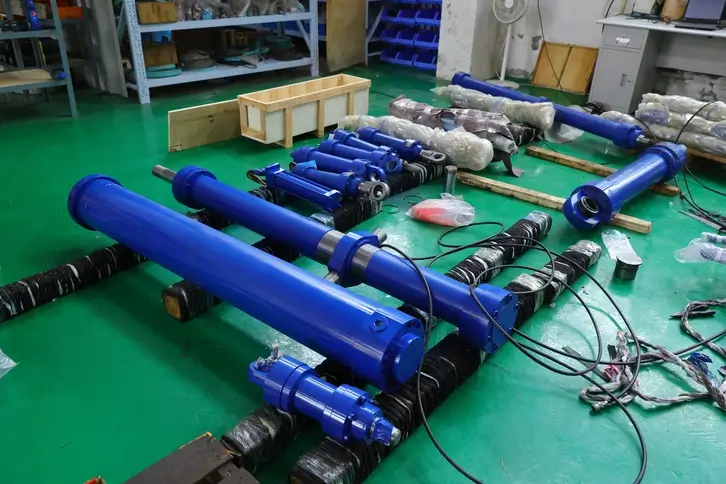
Engineering and manufacturing capabilities should be assessed based on evidence relevant to your project. During the evaluation, focus on whether the manufacturer can explain design choices, provide verified drawings, and describe how critical machining, welding, assembly, and inspection processes are controlled. For example, when purchasing a long-stroke cylinder, you can ask the manufacturer to explain how the risk of buckling under pressure on the piston rod is calculated. Equipment photos and factory floor area can provide background information, but process records, test results, and factory audit documentation for similar products are more valuable references.
Quality evaluation requires separate verification of the management system, product testing, and traceability capabilities. ISO 9001 is a quality management system standard and cannot substitute for the acceptance test results of a specific hydraulic cylinder; ISO 10100:2020, on the other hand, covers the acceptance and functional testing of hydraulic cylinders. For example, when a manufacturer provides a pressure resistance report, you should verify the model number, test conditions, and test results specified in the report. If the project requires long-term, high-frequency operation, further discussion regarding durability validation is necessary; a single successful factory test cannot be taken as proof of service life.
Global service capabilities must be tailored to your delivery location and maintenance needs. During your evaluation, focus on whether the manufacturer has accessible service channels in your target region and can provide technical documentation, replacement seals, and clear spare parts lead times. For example, just because a manufacturer exports to multiple countries does not mean they have stock or service personnel available in your location. For equipment where downtime costs are significant, you should confirm in advance the part numbers for maintenance kits, the supply method, and how spare parts will be matched following product revisions.
You can send the same set of drawings and operating conditions to candidate manufacturers, requesting that they each submit technical proposals, inspection plans, and scope of supply for comparison. For items for which you have not yet received quotes, test records, or audit results, mark them as “To Be Confirmed.” This approach is suitable for establishing a shortlist of procurement candidates; the final selection should still be based on sample verification, necessary factory audits, and contractual requirements.
Parker Hannifin offers hydraulic cylinders for industrial equipment and mobile machinery, including tie-rod, welded, telescopic, and custom cylinders. Rod-type cylinders connect the end caps to the cylinder barrel via external rods; telescopic cylinders utilize multi-stage sleeves to achieve a longer extension stroke within a shorter retracted length. Whether you need to select a model from the standard product line or develop a cylinder for specialized equipment, Parker provides the appropriate products and technical support channels.
Product lines, selection guides, and maintenance documents are key advantages to consider when evaluating Parker. Its publicly available documentation includes HMI metric hydraulic cylinders, 2H heavy-duty industrial hydraulic cylinders, as well as installation and maintenance instructions and seal repair kit catalogs for multiple series. For you, these resources help confirm installation dimensions, configuration options, and future maintenance requirements in advance—making them particularly suitable for procurement projects requiring standardized equipment specifications or long-term spare parts management.
If your equipment has specific installation space constraints, motion requirements, or control system needs, you can learn more about Parker’s customization services. However, the selection process should still be based on specific operating conditions. For example, when replacing an existing cylinder, even if the bore diameter and stroke are the same, you must verify the mounting hole spacing, retracted length, port specifications, operating pressure, and seal materials. Parker’s selection guide also emphasizes that load, speed, temperature, and mounting method must be considered comprehensively; suitability cannot be determined based on a single parameter alone.
Bosch Rexroth offers industrial hydraulic cylinders and配套 drive and control products. Its hydraulic cylinder series includes tie-rod and heavy-duty mill-type cylinders. Tie-rod cylinders connect the cylinder barrel to the end caps via external tie rods; heavy-duty Mill-Type cylinders, on the other hand, utilize a different cylinder body connection structure, and specific load-bearing capacities must be confirmed by model. If you need standard industrial hydraulic cylinders or wish to adjust the mounting, dimensions, and configuration of existing series, you can learn more about their product catalog and customization services.
The selection tools and system integration capabilities are key features worth noting when evaluating Bosch Rexroth. Their online hydraulic cylinder configuration tool supports selection based on force, stroke, and mounting position, and includes buckling calculations—that is, an assessment of the risk of buckling due to compression of the piston rod. For projects with long strokes or complex mounting conditions, such tools help you identify selection issues early on, though the final solution should still be confirmed based on actual loads and operating conditions.
If your equipment requires precise control of position, speed, or force, you should also consider how the cylinders integrate with sensors, control valves, and control systems. For example, Bosch Rexroth’s test equipment solutions include sensor-equipped hydraulic actuators that regulate motion via proportional or servo valves. These valves adjust fluid flow based on control signals and are suitable for test equipment requiring controlled loading or repetitive motion. The specific control performance depends on the compatibility of the entire system and cannot be determined solely by the cylinder brand.
Caterpillar’s hydraulic cylinder business primarily focuses on the needs for original equipment, repairs, and replacements for Cat equipment. If you are maintaining a Cat excavator, loader, or bulldozer, you can search for the corresponding hydraulic cylinders, piston rods, and seal repair kits through their parts channel. For these types of purchases, it is important to pay attention to the specific equipment compatibility information and the parts support required for subsequent repairs.
The comprehensive range of repair options is a clear point of focus when evaluating Caterpillar. Its official service offerings include seal replacement, component repair, rebuilds, and replacement with Cat Reman remanufactured parts or brand-new components. Remanufacturing is the process of inspecting, repairing, and replacing necessary parts on recovered components to meet specified requirements.
For example, if an oil cylinder is leaking externally, you can first have a technician inspect the seals, the piston rod surface, and the cylinder barrel before deciding whether to replace only the seals. If the piston rod or cylinder barrel is also damaged, simply replacing the seals may not resolve the issue. When requesting a quote, it is recommended to confirm the available repair options, parts availability, estimated completion time, and whether the use of remanufactured parts involves a trade-in requirement for the old parts.
When verifying compatibility, prioritize using the equipment serial number and the hydraulic cylinder part number. The Cat official parts platform allows you to search for cylinder and parts drawings for specific components based on the equipment serial number. For example, when purchasing a hydraulic cylinder for an excavator, you must specify whether it is for the boom, dipper, or bucket cylinder, and then verify the corresponding part number. If you are developing custom hydraulic cylinders for non-Cat equipment, you should separately confirm the scope of supply; you cannot directly treat the replacement parts catalog for existing machines as a universal catalog for custom products.
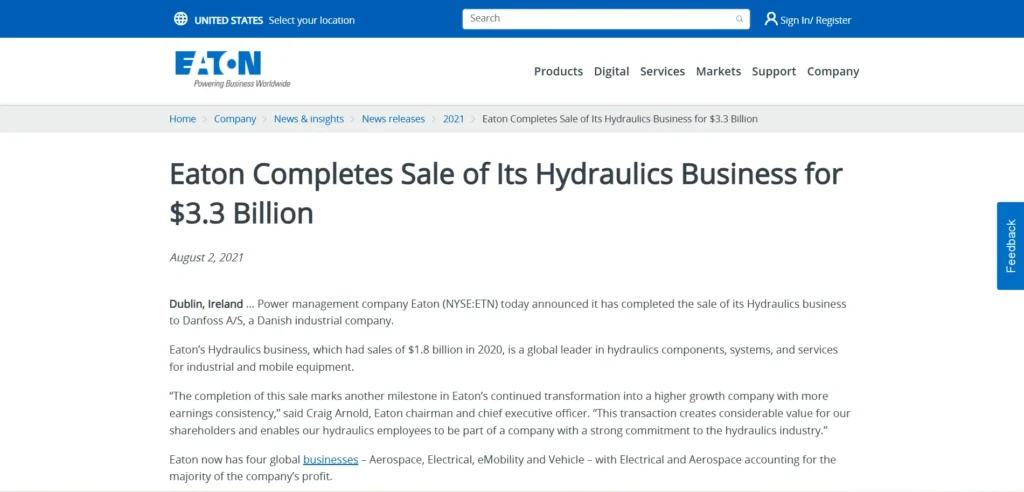
If you are looking for Eaton hydraulic cylinders, you first need to understand the changes in its business structure: Eaton completed the sale of its Hydraulics business to Danfoss on August 2, 2021, and that business was subsequently integrated into Danfoss Power Solutions. ** Therefore, when comparing current suppliers of hydraulic cylinders for industrial and mobile equipment, you need to evaluate them in light of Danfoss’s existing product line; you cannot directly treat Eaton’s past product catalog as its current product offering.
This product line remains worth noting. Danfoss currently offers hydraulic cylinders, pneumatic cylinders, and electro-hydraulic cylinders under the Vickers by Danfoss brand. Electro-hydraulic cylinders can be simply understood as actuators that combine electrical control with hydraulic drive, used in equipment requiring controlled motion. Officially listed applications include offshore drilling platform stabilization, wind turbine blade rotation, and production line operations. If your equipment involves these applications, you can further review specific series; however, similar application areas do not mean that any model can be directly substituted.
For equipment that currently uses Eaton hydraulic cylinders, the most practical approach is to first confirm the model number before discussing replacement options. When requesting a quote, you can provide a photo of the nameplate, the complete model number, mounting dimensions, operating pressure, and stroke—that is, the distance the piston rod can extend and retract. For example, when replacing a hydraulic cylinder on an older production line, even if the stroke of the new and old products is the same, you must still verify the mounting interfaces, port locations, and the compatibility of the seals with the hydraulic fluid. Placing an order based solely on visual similarity or brand name can easily lead to issues such as the cylinder not fitting or improper operation.
If your equipment requires custom hydraulic cylinders and you want to consider components such as sensors and control valves as part of the solution, HYDAC is worth adding to your shortlist. According to its official product documentation, HYDAC offers custom hydraulic cylinders and hydraulic cylinder systems that can be designed for specific mounting configurations, port layouts, seals, and piston rod surface coatings. It also provides solutions such as integrated valves and electronic position feedback. Position feedback can be simply understood as a way to let the control system know how far the piston rod has extended, facilitating the coordination of equipment movements.
One aspect of HYDAC worth noting is how its hydraulic cylinders integrate with the overall functionality of the machine. Its mobile hydraulic application documentation lists steering cylinders, suspension cylinders, locking and clamping cylinders, as well as hydraulic cylinders with position measurement capabilities. For example, if you are designing a mechanism that requires monitoring of steering movements, you can further evaluate steering cylinders with position feedback; if your mechanism only requires simple extension and retraction, you should first confirm whether these additional features are truly necessary to avoid incurring unnecessary procurement and maintenance costs.
When requesting a quote from Hydac, it is recommended that you provide load, operating pressure, stroke, installation space, and cycle frequency. Stroke refers to the distance the piston rod can extend and retract. If position feedback is required, you should specify the control system used by the equipment and the required signal interfaces. For example, simply asking, “Can you provide a cylinder with a sensor?” is not sufficient; you also need to confirm whether the sensor signal can be integrated into your existing controller and whether the entire system can achieve the required positioning accuracy.
If you need a compact hydraulic cylinder with clearly defined specifications, SMC is worth adding to your shortlist. Its official hydraulic cylinder catalog includes compact and round-body models, as well as series compliant with JIS (Japanese Industrial Standards). For example, the CHQ series consists of compact hydraulic cylinders, the CHN series features small-bore hydraulic cylinders, and the CH2 series offers a variety of pressure ratings and cylinder body materials. You can gradually narrow down your selection based on available space, required thrust, and mounting method.
When selecting SMC products, you must pay special attention to the fact that pressure ratings across different series cannot be mixed. Taking the CH2 series as an example, the nominal pressures listed in the official catalog are: 3.5 MPa for the CH2E, 7 MPa for the CH2F, and 14 MPa for the CH2G and CH2H. Nominal pressure is a parameter used to distinguish product design pressure ratings; specific operating conditions still require reference to the corresponding model specifications. Therefore, even if two cylinders have similar dimensions and stroke lengths, you cannot directly assume they are interchangeable.
Based on the structure and specifications of these products, you should prioritize evaluating them for equipment clamping, pushing, and similar mechanisms. For example, when selecting a cylinder for a fixture with limited installation space, you can first review the compact series and then verify the thrust, stroke, and mounting dimensions. If the equipment requires determining whether the piston rod has reached a specified position, you can also check configurations that include magnetic switches. These switches are primarily used to detect the “in-position” state and should not be interpreted as high-precision sensors capable of continuously measuring position. SMC’s relevant series offer options with switches; specific combinations should be confirmed in the catalog.

Wipro Infrastructure Engineering’s hydraulic business focuses on custom hydraulic cylinders and is worth considering for equipment manufacturers requiring complete system solutions. Its product lineup includes single-acting, double-acting, and multi-stage telescoping hydraulic cylinders, with applications spanning construction machinery, lifting equipment, agricultural machinery, forestry equipment, mining machinery, and trucks. If you are developing equipment and need to design hydraulic cylinders based on installation space, load, and motion requirements, you may want to include this company in your list of suppliers to evaluate.
One aspect of Wipro’s capabilities worth further examination is its approach to design and validation under actual operating conditions. Its official materials describe finite element analysis—a method of using computers to analyze the forces and deformations acting on parts—and explain that product validation takes into account materials, operating environments, duty cycles, and expected service life. For you, this means that when evaluating a solution, you should focus on “how its suitability for your equipment is verified,” rather than simply checking whether the cylinder dimensions match the drawings. The validation capabilities described in official materials cannot replace specific test reports for the models you intend to purchase.
When requesting a quote, we recommend providing installation drawings, operating pressure, maximum load, stroke, operating frequency, and estimated purchase quantity. For example, when purchasing hydraulic cylinders for forestry equipment, you should also specify operating conditions such as mud, moisture, and shock loads so that suppliers can evaluate the sealing, protection, and structural design accordingly.
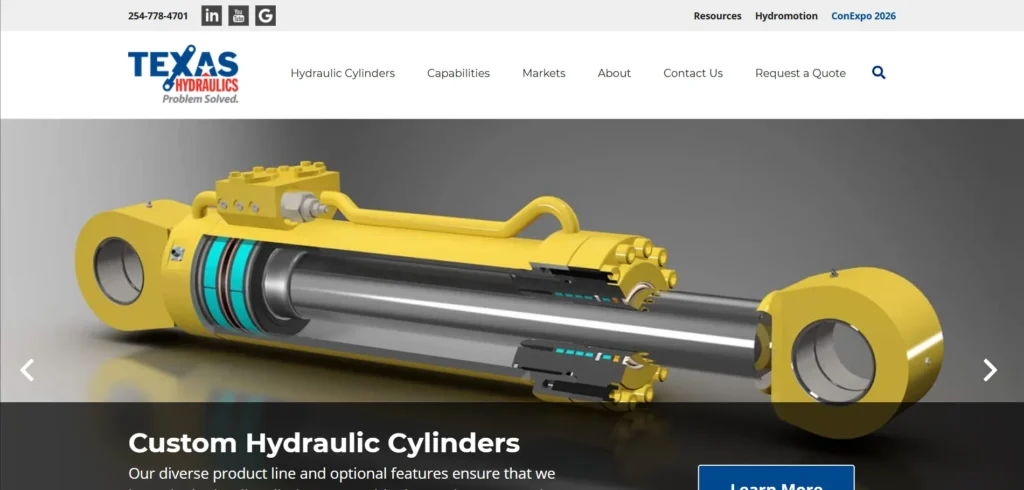
Texas Hydraulics is a U.S.-based manufacturer specializing in custom welded hydraulic cylinders, making it a company worth considering for buyers seeking equipment integration and functional integration. The company has been manufacturing hydraulic components since 1968, providing custom products to original equipment manufacturers. Welded hydraulic cylinders typically connect the cylinder barrel and end caps via welding, making them easy to integrate into equipment’s spatial design. If your project has specific requirements regarding mounting dimensions, port locations, or additional control functions, you may want to further evaluate their solutions.
Texas Hydraulics’ product lineup includes hydraulic cylinders for construction machinery, telescopic cylinders, hydraulic cylinders with position sensing, as well as integrated valve and all-in-one drive solutions. Among these, hydraulic cylinders with integrated valves are a noteworthy option: they incorporate some control valve functions directly into the cylinder assembly, reducing the number of piping connections between the cylinder and an external valve block. Officially listed optional features include load holding, overload protection, and flow control; however, specific configurations must be confirmed on a project-by-project basis, as not every cylinder offers all features.
For example, if you are designing a space-constrained lifting mechanism, you might inquire whether integrating the load-holding function into the cylinder is appropriate. Simply put, this function helps the load maintain its position under specified conditions. During the evaluation, you will also need to provide information on load variations, descent speed, and the hydraulic circuit so that the supplier can confirm the valve type and settings. A high degree of integration does not automatically mean it is the best fit for your equipment; maintenance space and component replacement methods must also be taken into account.
9. Ligon Hydraulics
Ligon Hydraulics is a hydraulic cylinder group comprising several U.S.-based manufacturing companies that specializes in providing custom hydraulic cylinders and related products. If you need production based on drawings or want a supplier to participate in the design process according to your equipment requirements, you may want to include them in your shortlist. When making a purchase, you’ll need to confirm which specific member company will handle the project, as the group’s overall product range does not mean every facility has the same manufacturing capabilities.
Ligon’s hydraulic cylinder products include welded and threaded connection designs, multi-stage telescoping designs, and designs with bolted cylinder heads. The company’s website lists hydraulic cylinders with bolted cylinder heads as an option for applications such as excavators, mining, and forestry equipment; this design also facilitates disassembly and maintenance. If your equipment is subjected to repeated loads over the long term, in addition to verifying the working pressure, you should also have the supplier evaluate the operating frequency, shock loads, and maintenance requirements; you cannot rely solely on the “heavy-duty” designation to determine suitability.
For equipment with limited installation space when retracted but requiring a long extension distance during operation, you may want to focus on their multi-stage telescopic cylinders. Official documentation states that Ligon can provide multi-stage hydraulic cylinders with up to six stages and supports manufacturing according to customer designs or the development of customized solutions. However, a higher number of stages does not necessarily mean it is better suited for your project. For example, when evaluating lifting mechanisms, you must also consider the thrust at each stage, the extension sequence, and installation stability—you cannot simply compare the total stroke.
When requesting a quote from Ligon, we recommend submitting installation drawings, load variations, operating pressure, stroke, operating environment, and estimated purchase volume. Also, request that the quote clearly specify the manufacturing facility, design responsibilities, sample verification requirements, and spare parts supply arrangements. If you already have finalized drawings, focus on confirming manufacturing and inspection requirements; if you need the supplier to participate in the design process, you should first establish performance targets and acceptance criteria. For overseas procurement, you should also verify export arrangements, shipping lead times, and after-sales response procedures, ensuring that engineering capabilities are evaluated alongside actual delivery requirements.
10. Jiangsu Hengli Hydraulic
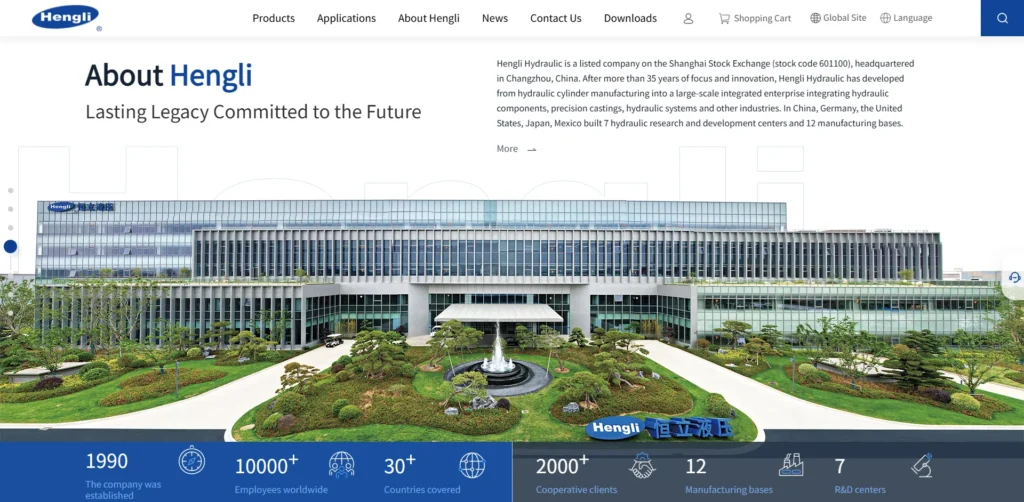
Jiangsu Hengli Hydraulics is a hydraulic cylinder manufacturer worth considering for purchasers of construction machinery and heavy-duty equipment. Its business has expanded from hydraulic cylinders to include hydraulic pumps, valves, motors, and hydraulic systems, with cylinder products covering applications such as excavators, industrial equipment, and tunnel boring machines. If you need to develop cylinders for new equipment or evaluate the compatibility of multiple hydraulic components simultaneously, you should include Hengli on your shortlist.
Excavator cylinders provide a clear starting point for evaluating Hengli’s product line. Its official website lists cylinders for both small and large excavators, including boom cylinders, dipper arm cylinders, and bucket cylinders, and notes that customization is available based on customer requirements. These types of cylinders are responsible for lifting the boom, driving the dipper arm, and controlling the bucket, respectively, and each faces different load conditions and mounting requirements. Therefore, if you are looking for replacement parts, in addition to the equipment model, you should also provide the original cylinder part number, mounting dimensions, and port locations; you cannot determine compatibility based solely on the excavator’s tonnage.
For heavy-duty applications, Hengli’s specifications for large excavator hydraulic cylinders list options such as surface corrosion protection, integrated valve assemblies, and cushioning designs. Cushioning refers to the mechanism that slows movement as the cylinder approaches the end of its stroke, thereby reducing impact. For example, if your hydraulic cylinder is exposed to a humid environment for extended periods, you should focus on discussing corrosion protection solutions for the piston rod; if the mechanism frequently extends and retracts while承受ing impacts, you’ll need to further evaluate cushioning and fatigue life—that is, the component’s ability to withstand repeated loads.
Manufacturer Comparison by Cylinder Type and End Market
When comparing hydraulic cylinder manufacturers, you should first determine what type of design your equipment requires, and then assess whether the supplier is familiar with the corresponding application scenarios. The end market refers to the equipment or industry where the hydraulic cylinder will ultimately be used, such as excavators, production lines, agricultural machinery, or mining equipment. Even among companies that offer custom hydraulic cylinders, their suitability may vary in terms of product dimensions, control functions, mass production capabilities, and maintenance support. The comparison below is intended to help you establish a shortlist of procurement candidates; it does not represent a ranking of quality, nor is it a complete product catalog for each brand.
First, understand a few common terms: pull-rod hydraulic cylinders use external pull rods to secure the end caps to the cylinder barrel; welded hydraulic cylinders employ welded connections for part of the cylinder body structure; multi-stage telescopic cylinders extend through multiple sections of sleeves to achieve a longer stroke within a limited installation length. Heavy-duty industrial cylinders are designed to withstand more demanding industrial conditions, but their specific load-bearing capacity still depends on design parameters. Integrated valves and position sensing are additional features that can be combined with different cylinder configurations; they should not be treated as mutually exclusive categories.
| Manufacturer | Key Hydraulic Cylinder Types or Solutions | Relevant End Markets and Procurement Entry Points |
|---|---|---|
| Parker Hannifin | Rod-type, welded, telescopic, and custom cylinders | Industrial equipment, as well as trucks, sanitation, mining, and material handling equipment; suitable for comparing both standard series and custom solutions. |
| Bosch Rexroth | Rod-type, heavy-duty industrial cylinders | Industrial machinery and hydraulic system projects; evaluate based on model configurations and system requirements. |
| Caterpillar | Cylinders, cylinder rods, and remanufactured parts for Cat equipment | Maintenance and replacement for existing Cat equipment; start by matching the equipment serial number and part number. |
| Eaton Hydraulics | Verify compatibility of relevant products against Danfoss's current product lines | The former Eaton Hydraulics business was sold to Danfoss in 2021; when procuring replacement parts for older models, confirm current model equivalents and support channels. |
| HYDAC | Custom cylinders, steering cylinders, suspension cylinders, and cylinder systems with integrated control functions | Projects involving mobile machinery and equipment requiring valves and position feedback. |
| SMC Corporation | Compact, small-bore, and JIS series hydraulic cylinders | Prioritize evaluation for clamping and pushing mechanisms with limited installation space; verify pressure ratings for specific series. |
| Wipro Infrastructure Engineering | Custom single-acting, double-acting, and telescopic cylinders | Construction machinery, agriculture, forestry, mining, lifting equipment, and truck applications. |
| Texas Hydraulics | Custom welded, telescopic, integrated valve, and position detection solutions | Material handling, agricultural, and utility operation equipment; priority can be given to discussions regarding piping layout and control function integration. |
| Ligon Hydraulics | Welded and threaded, multi-stage telescopic, and bolted cylinder head types | Construction, mining, forestry, and transportation equipment; the member companies responsible for the project and their specific capabilities must be confirmed. |
| Jiangsu Hengli Hydraulic | Excavator cylinders, industrial work cylinders, and cylinders for tunnel boring equipment | Construction machinery and heavy-duty equipment projects; custom solutions can be evaluated based on the machine's load and installation conditions. |
When actually screening options, you can start by narrowing down the field based on application. For example, when replacing the boom cylinder on a Cat excavator, you can verify compatibility using the Cat parts catalog; when developing a new clamping device, you can compare compact or industrial cylinder solutions that meet space and thrust requirements; and when seeking a longer lifting stroke for dump trucks, you can submit installation drawings to manufacturers that offer telescopic cylinders. These are examples of selection based on product ranges; final suitability still requires model-specific and engineering verification.
Do not interpret “same type, same industry” as “directly interchangeable.” For example, two cylinders with the same stroke may differ in retracted installation length, pin bore diameter, port threads, and allowable pressure. Long-term, frequent reciprocating motion versus occasional lifting also imposes different durability requirements; comparing solely based on maximum pressure or lowest price can easily overlook factors that affect service life and maintenance costs.
How to Match a Manufacturer to Your Application
First, clarify the equipment’s operational requirements, then evaluate the manufacturer’s design, validation, and supply capabilities. Experience in the industry can help you narrow down your options, but the specific product must still be compatible with the load, installation conditions, and operating environment.
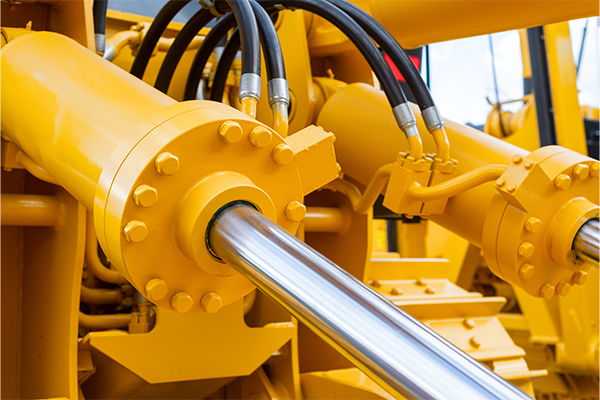
① Define Your Operating Requirements
Inform the supplier of the load to be pushed or pulled, the travel distance, the required speed, and the system’s pressure and flow rate. Flow rate refers to the volume of hydraulic fluid supplied per unit of time and affects movement speed. For example, loading and unloading equipment that operates frequently cannot be selected based solely on the same cylinder bore and stroke as lifting equipment used only occasionally.
② Check Mounting and Load Conditions
Provide installation drawings so the supplier can verify rod diameter, support, and connection methods. Long-stroke compression cylinders require an assessment of buckling resistance—that is, the piston rod’s ability to resist buckling instability under compression. If off-center installation creates lateral loads (forces acting sideways on the piston rod), simply increasing the cylinder’s pressure rating will not resolve wear issues.
③ Match Materials to the Environment
Specify the type of hydraulic fluid, fluid temperature, ambient temperature, as well as conditions involving silt, moisture, and corrosion. For example, outdoor equipment requires attention to corrosion and dust protection, while equipment operating at high fluid temperatures requires verification of the suitability of sealing materials. Require suppliers to provide specific materials and validation documentation; do not accept mere assurances that a product is “suitable for harsh environments.”
④ Choose the Right Level of Customization
When standard products meet requirements, prioritize comparing delivery times and ease of maintenance; evaluate customization capabilities only when interfaces are unique or integration with valves and sensors is required. For example, if the cylinder needs to stop precisely at a specified position, clearly define the allowable positional error. The mere presence of “sensors” does not guarantee positioning accuracy; the compatibility of valves and controllers must also be verified.
⑤ Verify Testing and Supply Support
Send the same set of requirements to two or three candidate manufacturers, requesting item-by-item explanations of compliance, design deviations, and verification methods. For new designs, agree on acceptance criteria for prototypes; for replacement parts, verify part numbers and interfaces. For ongoing procurement, also confirm the manufacturing facility, batch delivery schedules, drawing change management, and the supply of repair spare parts.
Due Diligence Before Requesting a Quote
Who Is the Largest Hydraulic Cylinder Manufacturer in the World?
It is not possible to directly identify a single company as the world’s largest without considering the specific criteria used for the analysis. Results may vary depending on whether the comparison is based on hydraulic cylinder production volume, sales revenue, manufacturing scale, or whether products for a manufacturer’s own use are included. Wipro describes itself as one of the world’s largest independent hydraulic cylinder manufacturers, but this does not equate to being ranked number one globally based on a standardized set of criteria. When sourcing, you should focus on verifying whether the manufacturer has the capacity to meet your specific product dimensions, technical requirements, and order volume.
Which Manufacturers Specialize in Heavy-Duty Hydraulic Cylinders?
Bosch Rexroth, Jiangsu Hengli Hydraulics, and companies under the Ligon umbrella all offer heavy-duty hydraulic cylinder products worth evaluating. Rexroth offers heavy-duty industrial cylinders, Hengli provides large excavator cylinders, and Ligon’s bolted-end cap products cover applications such as mining and forestry. However, there is no simple “heavy-duty” threshold that applies to all projects; you need to consider operating pressure, shock loads, and cycle frequency—you cannot rely solely on cylinder bore size.
Which Hydraulic Cylinder Brands Have the Widest Global Service Network?
Parker, Bosch Rexroth, and Caterpillar all provide official distribution or service channels, but in the absence of standardized data, it is not advisable to provide a definitive ranking for “the widest network.” What is more valuable to you is verifying whether there is repair capability, seal inventory, and technical support for the specific product near where the equipment will be used. For example, for Cat equipment repairs, you can start with a local Cat dealer; for industrial hydraulic cylinders, you should confirm that the local service center actually handles that specific series, rather than just selling other products from the same brand.
Do Leading Manufacturers Offer Custom Hydraulic Cylinders?
Many manufacturers offer customization services, but the scope of customization and order acceptance conditions vary. Wipro, HYDAC, Texas Hydraulics, and Ligon have all publicly outlined their capabilities for custom hydraulic cylinders. You’ll need to specify whether you’re modifying mounting interfaces, manufacturing according to existing drawings, or requesting a complete redesign from the manufacturer, and confirm prototype costs, minimum order quantities, and responsibility for validation. The workload required to simply change the stroke is not comparable to that of developing a new structure with an integrated valve.
How Should Buyers Compare Hydraulic Cylinder Warranties?
When comparing warranties, you should consider the warranty period, the start date, the scope of coverage, and the claims process, and confirm whether there are any operating-hour limits. Be sure to clarify how costs for seals, labor, disassembly and reassembly, shipping, and on-site service are handled, as well as how damage caused by contamination, installation errors, or operating conditions beyond specified limits is assessed. For example, if two quotes have the same warranty duration but one covers only parts replacement while the other also covers a portion of labor costs, their actual value differs. Request that the supplier provide written terms applicable to the specific order and confirm whether authorization is required before disassembly and repair.
What Standards Apply to Industrial Hydraulic Cylinders?
Common standards address various matters: ISO 6020-2 specifies mounting dimensions for 16 MPa (160 bar) compact-series single-rod hydraulic cylinders; ISO 10100 covers the acceptance and functional testing of hydraulic cylinders; ISO 4413 covers general rules and safety requirements for hydraulic systems and their components. These standards are not interchangeable, nor must all custom cylinders adhere to the same size series. You should clearly specify the applicable standards, versions, and acceptance requirements in your request for quotation; compliance with installation dimension standards does not automatically mean that sealing, durability, or overall system performance will meet your needs.
Are Premium Hydraulic Cylinder Brands Worth the Higher Cost?
Whether it is worth it depends on whether the higher price delivers verifiable value in use. For equipment with high downtime costs, difficult maintenance, or stringent control requirements, mature design support, a reliable supply of spare parts, and local repair services may justify the additional investment. For standard hydraulic cylinders with clearly defined operating conditions that are easy to replace, it is also worth comparing other manufacturers that meet the requirements. You should evaluate procurement, installation, maintenance, and downtime costs together, and avoid assuming that a brand premium is direct proof of a longer service life.
Choosing a Trusted Hydraulic Cylinder Manufacturer
From standard hydraulic cylinders to custom solutions, we help you improve equipment performance, delivery reliability, and batch consistency
Explore Rivmate Cases

Hey There, I'm Melody!
We are a hydraulic cylinder manufacturer. For over 20 years, we have focused on producing reliable hydraulic cylinders. Need a hydraulic cylinder solution? Feel free to contact us.